Restaurant table reservation - queue system
The pandemic has surely crushed the concept of dining at restaurants, even if we were to go back to normal in the coming year, social distancing has to be a top priority. We have all many times in our life been standing for hours outside a restaurant waiting for a table to be available. It can take hours and the excitement with which people leave their house is definitely compromised. Therefore, online reservations are going to be extremely useful henceforth.
Duration: 2 weeks (December 2020)
Tools: Figma, Blender

an idea takes form
Online reservations can be taken a step further where we not only provide customers with a way to book a table but rather book and wait for a table of their choice. Giving customers the option to choose a table just like a preferred seat in the theatre or a comfortable seat during a flight, can help us enhance their dining experience.
why?
1. Social distancing: No long lines, and when booked online the restaurant can be prepared to greet the customers ensuring their safety.
2. Traffic management: When the restaurant has the customer list beforehand, they can easily manage rush hours.
3. Personalised experience: When the restaurant already knows which customer is arriving they can professionally greet them and take care of their needs.
4. Customers have the control: Allowing the customers to choose the time they would want to be notified makes waiting less overwhelming.
5. Customer loyalty and satisfaction: Once given the desired experience guarantees customer satisfaction, in turn providing the restaurant with loyal customers.
an existing foundation can be used
People use food delivery apps all the time. Recently these services have stated online table bookings as well. The rate with which these platforms have grown and are now a part of our day-to-day lives is astonishing.
Some platforms like Zomato have business models that restaurants use to accept and manage bookings.
goals are set
This mini-project here is about giving another side to these business models, providing the customers the data, layout of the restaurant, and letting them book for themselves.
The restaurant will take bookings for walk-in customers whereas others will be automatically updated to the restaurant database when people book from their own devices.
looking at the users

RESERVATION SYSTEM
When the customer has made a choice and lands on that particular restaurant's page he will be provided with all the information needed. Address, ratings, contact, directions, etc.
Now it's time to check the tables.
Step 1: Select the date and time for your reservation.
Step 2: Explore the floor plan of the restaurant and check the availability of tables from the database represented on the screen.
Step 3: Choose a table, click on it to select.
Step 4: Once you select the table of your choice you are prompted to either reserve it directly or join the queue depending on the availability of the table.
Step 5: Fill in your details if you are a first time user and tell the restaurant when you would want to be notified.
Step 6: Confirm reservation or position in the queue with one last click.
TaBLE SELECTION
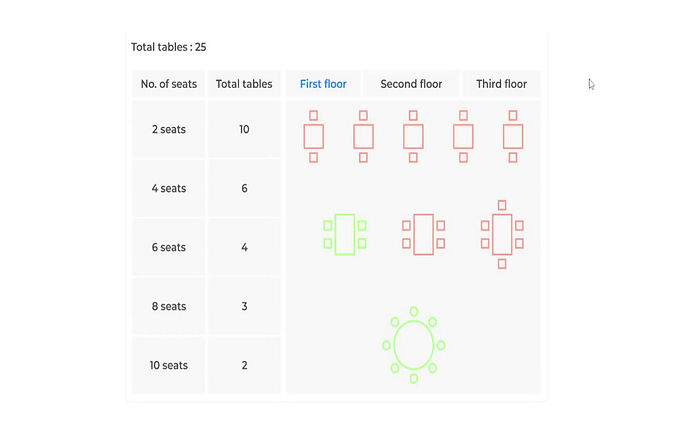
Providing the choice to select the desired table is the main goal. Therefore, I tried to design a chart showing the arrangement and distribution of tables on different floors (if multiple).
It shows the total number of tables at the restaurant, further distributed according to the number of seats. Also showing the arrangement of each floor.
Evolution of design
First attempt

Another go at it
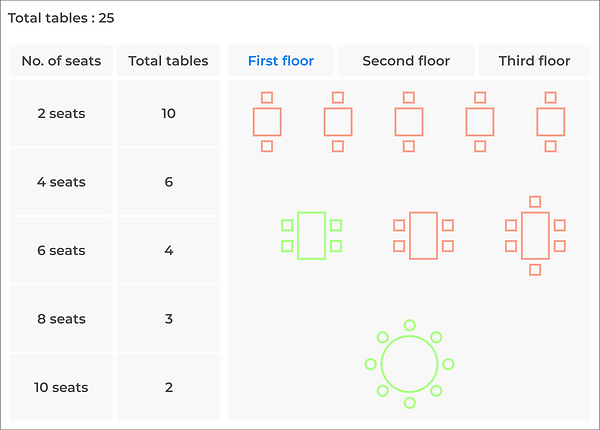
The application that restaurants use on tablets is a similar model. There they can easily change the arrangement of tables and if this were to be implemented by connecting both the models to one main database the same changes will be updated here as well.
Below depicted are two scenarios of what might happen when a customer has already selected the restaurant and is now ready to book a table.
CASE 1:
The table the customer wants is available.

1
Select the table of choice and click reserve table button.
2
Fill in the details and confirm the reservation.
The table will be held for 10 minutes.

3
A confirmation message will be displayed.
You can also cancel the reservation.

CASE 2:
The table the customer wants is not available.

1
Select the table of choice and click the reserve table button.
2
This message will appear.
To wait in the queue go ahead and join.

3
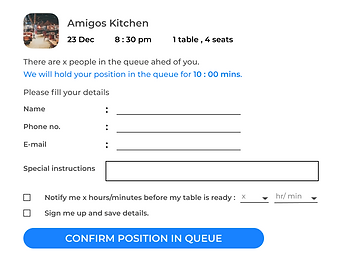
Fill in the details and confirm the reservation.
You get 10 minutes to confirm your position in the queue.
Giving customers the control: Customers can set reminder time, no bombarding them with constant update messages.
4
A confirmation message will be displayed.
You can leave the queue and the next person's position will be automatically updated.

Whenever two people want the same table, first come first serve is applied; the customer who came first gets preference and if they fail to complete the steps within the given time say 10 minutes then the status of the table remains unchanged and the next person gets to book it.
Things that will need to be considered to execute the system efficiently:
1. The layout will have to be consistently updated automatically whenever changes are made by the restaurant.
2. If a person leaves the queue, the next person should be notified accordingly.
3. To predict waiting time in the queue average dining times will have to be recorded, so when notifications are sent out to customers in the queue there won't be much confusion.
in retrospect
This is by no means a complete project. The only goal I set was to design a way for customers to be able to select tables by looking at the restaurant layout.
The internal database setup is going to be much more complicated than it appears in the above-illustrated steps.
The Beginning


Future additions:
1. When someone leaves the queue, the next customer can choose to move ahead in the queue or allow others to join before them.
2. Place order after reserving a table.
3. Table availability status automatically changes after bill payment.
4. Calling waiters with a nudge on the app when you have reserved a table.
THINKING BACK
The original idea was to design a model for hospital appointments. But a quick google search showed that it has already been made. This idea isn't unique as well but to me seems more challenging than it sounds. Many more questions would have arisen had I worked directly with the restaurant management or known the internal workings of the same.
Research and data will play a major role in the smooth execution of a system like this.
I have seen restaurants appointing one person simply to take bookings on a tablet app. The idea is to eliminate that extra point of contact. Before applications like "Book my show" were introduced, seats in the theatre were given to us according to availability at the time we went to the place. But now we have the luxury to choose our seats beforehand. That is exactly what my intention for this project was.